
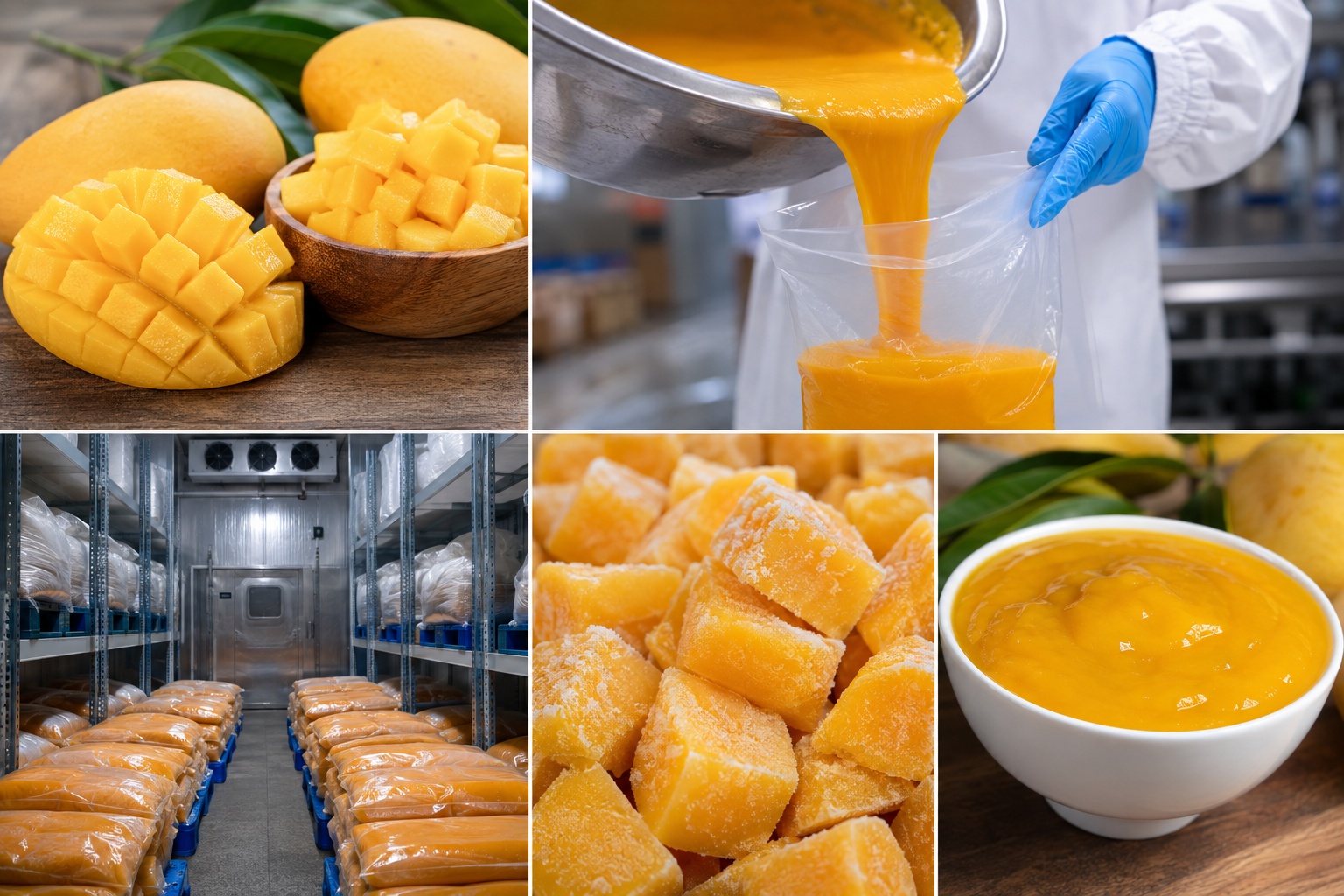
Five ways to keep pulp
For buyers, NPD and QA teams sourcing bulk fruit pulp and purée
Fruit spoils. Every pulp on the market is a different bargain struck with that fact — some trade away colour, some trade away shelf life, some trade away the markets you can sell into.
Three processes work against pulp at once: microorganisms ferment the sugars, the fruit's own enzymes brown the colour, and oxygen oxidises vitamin C, carotenoids and aroma. Chemistry, cold, heat and barrier packaging are the four tools available.
What you are actually buying
Each format is named by the barrier it relies on, because that is what determines how it behaves in your factory.
The trade-offs in one table
Figures come from separate sources and are drawn together for orientation, not as one experiment.
| Format | Holds it with | Shelf life | Storage | Preservative | Main quality cost |
|---|---|---|---|---|---|
| Chemically preserved | SO₂, benzoate, sorbate | ~6 mo ambient · ~10 mo at 4 °C | Ambient | Yes, declarable | Bleached colour, sulphurous note, export restrictions |
| Frozen | Cold | 8–12 mo quality life | −18 °C, unbroken | No | None material — the cost is logistical |
| Pasteurised / hot-fill | Heat, then pack | Short to medium | Chilled or ambient | Sometimes | Long hold times degrade vitamin C and carotenoids |
| Canned | Heat in container | Long | Ambient | No | Overcooking at the pack wall; cooked notes |
| Aseptic | Heat in flow + sterile pack | 12–18 mo ambient (typ. spec) | Ambient | No | Slow drift in colour and flavour over ambient storage |
Why SO₂ decides which markets you can sell into
This is the part of the decision that has nothing to do with taste. Sulphite limits differ by an order of magnitude between the market you buy in and the markets you may want to sell in.
- India, industrial-use pulp — 1,000 ppm. The FSSAI category for pulp with preservatives.
- Codex GSFA — 100 mg/kg. Fruit preparations including pulp and purées.
- Japan — 30 ppm. The "other foods" residual category.
- Allergen declaration — 10 ppm. In India, the EU and the USA alike, sulphites above this level must be declared.
The European position is stricter still. Under the EU Fruit Juice Directive as amended, the list of treatments and substances authorised for fruit juice and fruit purée is exhaustive — and no preservative appears on it. Not sulphur dioxide, not benzoate, not sorbate. Sulphites above 10 mg/kg must in any case be declared as an allergen under EU labelling law, and undeclared sulphites are a recurring authenticity violation flagged to European buyers in this exact product category.
What aseptic does not do
We make aseptic pulp, so it is worth being straight about its limits. Aseptic is not a freeze-frame: work on aseptically packed mango purée found colour and flavour declining after eight months of ambient storage in every time–temperature combination tested. Sterile does not mean static.
A twenty-week study of bulk mango pulp found vitamin C, polyphenols, antioxidant capacity and β-carotene degrading two to four and a half times faster at 28 °C than at 4 °C. Aseptic removes the processing penalty and the preservatives — it does not repeal chemistry. The right question is not which format is best, but which trade you can most afford to make.
Six questions worth asking any pulp supplier
- What exactly is in it, at what level? SO₂, benzoate and sorbate in ppm, not a yes-or-no.
- What is the time–temperature schedule? The hold time, not the peak, governs what you receive.
- Safety life or quality life? Different claims. For frozen, the number is usually quality.
- What is the pack barrier? Oxygen ingress governs ascorbic acid retention independently of sterility.
- Fill weight, and in what drum? 215 L is common; net weight is roughly 200–230 kg. Contract on kilograms.
- A COA per batch — and will it match? Brix, acidity, pH, microbiology, from the same place as the spec.
Request a sample drum and a batch COA
We make preservative-free aseptic fruit pulp at the farm gate — mango, tomato, guava, citrus and Himalayan fruits — and build the mobile aseptic processing units that produce it.
Sources: FAO Bulletins 119 and 158; Codex CXC 40-1993 and CODEX STAN 192-1995; EFSA Journal 2022;20(11):7594; Directive 2012/12/EU; Regulation (EU) No 1169/2011; FSS (Advertising and Claims) Regulations, 2018; CBI and APEDA. Regulatory limits change — verify current values before making a labelling or export decision.